By Lewis Nibbelin, Contributing Writer, Triple-I
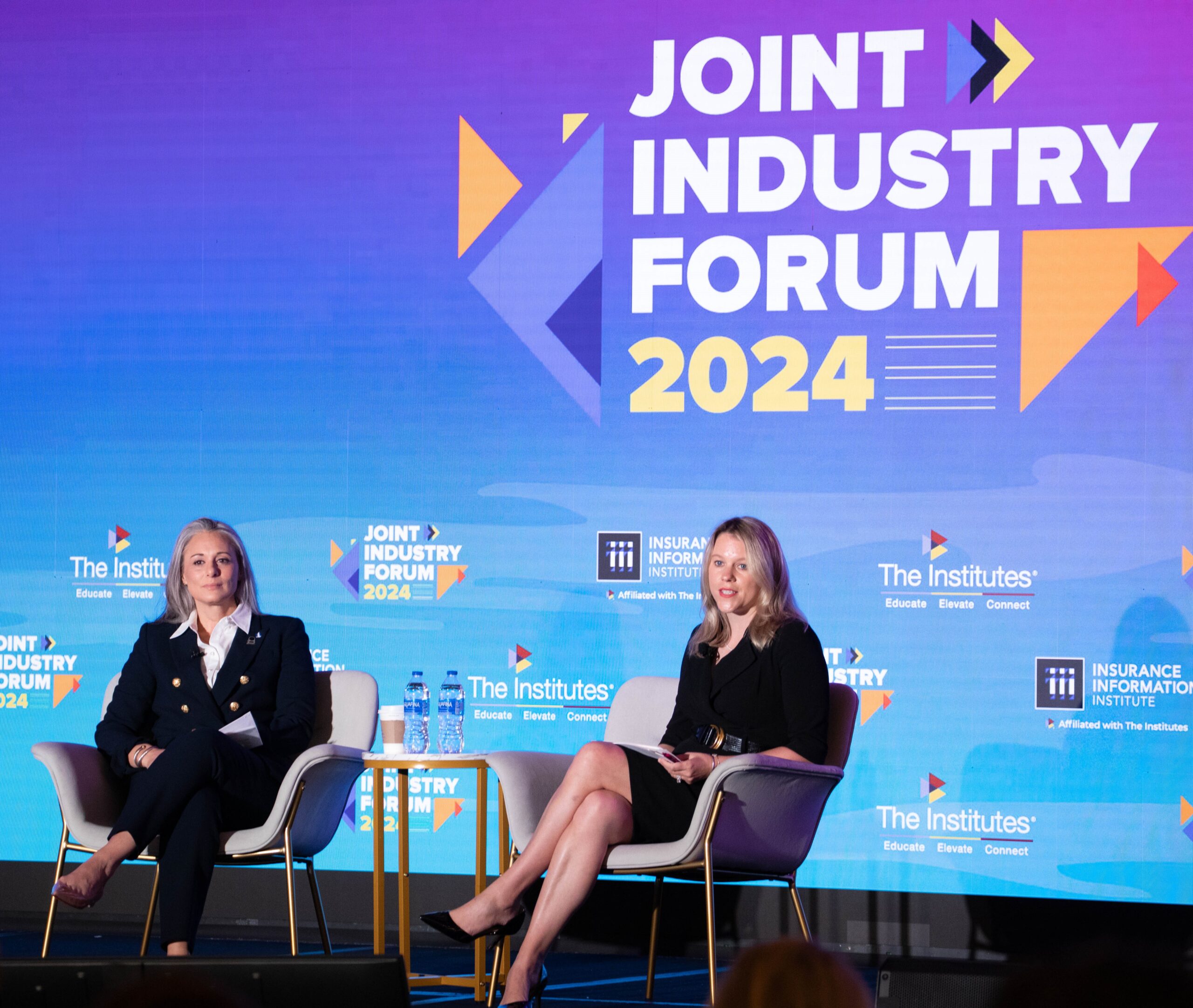
Maintaining human centricity in an increasingly digitized world was a focus of discussion for many participants at Triple-I’s 2024 Joint Industry Forum (JIF) – particularly during the “Fireside Chat,” featuring Katherine Horowitz, executive vice president and head of business units for The Institutes, and Casey Kempton, president of personal lines at Nationwide.
As generative AI and other technological innovations help streamline the insurance value chain, such processes must continue to align with the human needs intrinsic to insurance, Kempton stressed.
“91´«ý is a human business,” Kempton said. “The moment of a claim – of whatever tragedy or inconvenience that has happened – is a human moment. Theres’s emotion involved in that. I don’t expect any robot or machine to take on that experience end-to-end and be able to deliver what folks need in that moment, which is comfort and assurance.”
Rather, new technology presents opportunities to facilitate more proactive and individualized risk management than ever before, while also enabling employees to do what this industry does best: engaging with other people.
Role of telematics
Usage-based insurance, for instance, allows insurers to tailor auto rates based on the policyholder’s driving behavior, tracked by telematics. By providing feedback to encourage safer driving habits, telematics has been to lower risk and reduce auto premiums, empowering consumers to recognize their direct influence on their insurance rates, Kempton said.
Similarly, advanced smart devices – such as those developed by Whisker Labs (Ting) and Ondo InsurTech (LeakBot) – continuously detect conditions that could lead to damage within a home and notify homeowners before losses occur. The success of these devices has spurred numerous insurance carriers, including Nationwide, to pay for and distribute them to customers.
“Supporting the delivery of these technologies to our customers is critical,” Kempton explained, as is “making the cost of entry accessible.”
Words matter
Kempton noted that mitigative insurance solutions further serve to alleviate widespread public distrust in the industry, which has become “sullied” under misconceptions of insurance as merely a commodity.
Industry language fixated on costs, rather than consumer needs, is partly to blame.
“In insurance, we talk about ‘mitigating loss,’” Kempton said. “That’s how it feels from our perspective – we see claims as losses – but let’s turn that into, ‘how can [insurers] better engender peace of mind and protection for consumers?’”
Louisiana 91´«ý Commissioner Tim Temple later echoed this sentiment during a panel on legal system abuse, discussing how “billboard attorney” advertising has appropriated the consumer confidence once placed in insurance carriers.
“I remember when insurance companies advertised dependability and stability,” Temple explained. “Now it’s lizards, birds, and jingles… And then you see the attorneys, and they talk about how you’re going to be safe and secure with their service. That’s [the insurance company’s] job.”
Fueled by such advertising, excessive claims-related litigation has cost residents of Louisiana and other states across the country thousands of dollars in “tort taxes” every year, contributing to rising premium rates as insurers struggle to predict and mitigate protracted claims disputes. Lack of transparency around third-party litigation funding (TPLF), in which investors fund lawsuits in exchange for a percentage of any settlement, exacerbates this financial strain.
“If we can avoid these additional expenses and the severity attached to nuclear verdicts, it benefits all consumers,” Kempton said. Recent reforms in Florida – once the poster child for legal system abuse – indicate as much.
But reform necessarily hinges on collaboration between all stakeholders, which is unattainable without resolving “the consumer mindset we’ve inadvertently created around what the value of insurance is,” Kempton said. Updated legal regulations are equally important to ending legal system abuse as reasserting the key values of insurers – to protect and care for policyholders.